Germline Variants in Patients with Sporadic Gastric Cancer from Southwestern Colombia
DOI:
https://doi.org/10.22516/25007440.1511Keywords:
Neoplasms, germ-line mutation, exome sequencing, genetic variationAbstract
Introduction: Gastric cancer (GC) is a major public health problem worldwide, and Colombia is among the regions with the highest incidence. Multiple factors contribute to its development, including germline mutations (hereditary disease), which influence individual susceptibility.
Objective: To identify germline variants in the exome of patients diagnosed with sporadic GC from regions of high and low incidence in Colombia.
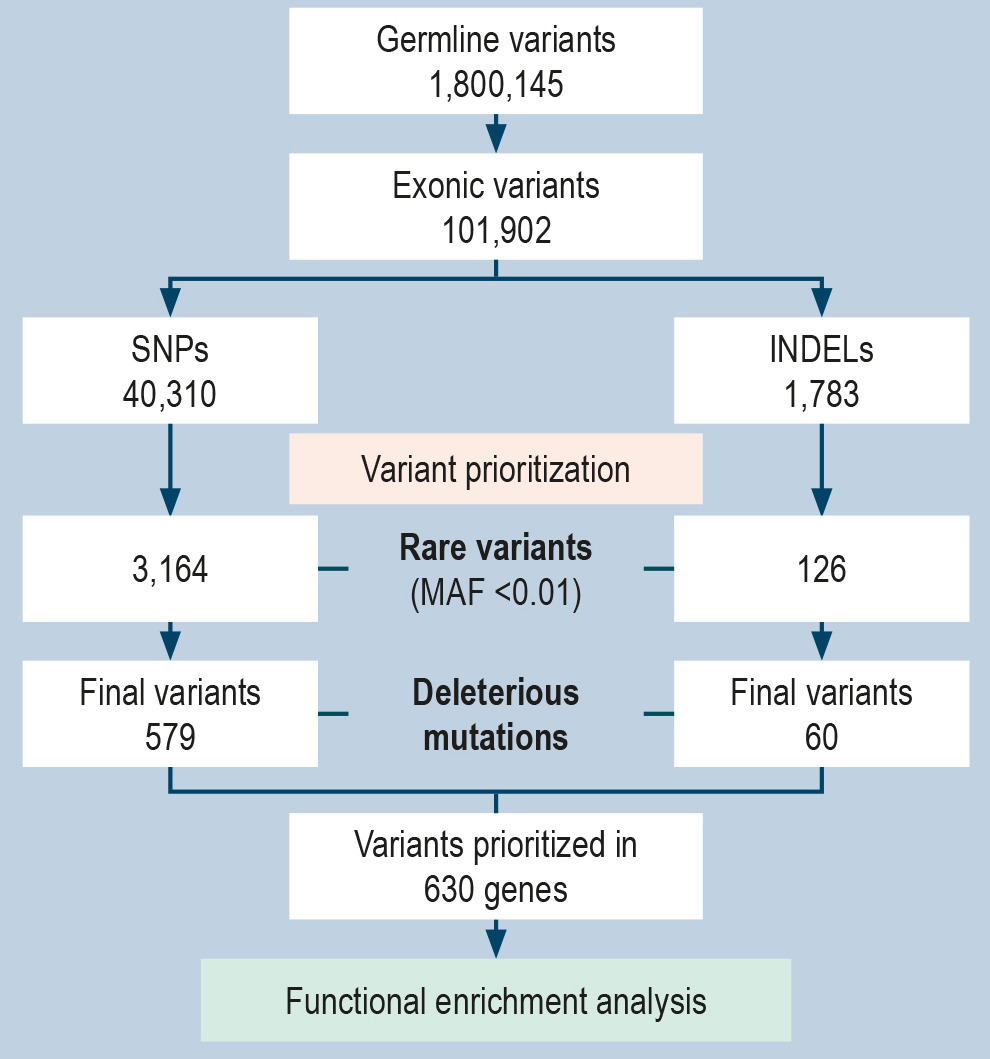
Materials and methods: Four blood samples were collected from patients with GC in the department of Nariño, Colombia, for whole-exome sequencing (WES). Bioinformatic analysis included raw data quality control, alignment of reads to the human reference genome, variant calling, annotation, filtering and prioritization, data visualization, and functional pathway analysis of genes harboring deleterious variants.
Results: A total of 1,800,145 germline variants were identified in the analyzed patients. Five of these variants were reported in ClinVar as pathogenic, and these genetic alterations have not been previously described in patients with GC. The variants were identified in the genes ACADS (rs57443665), BRCA1 (rs55688530), FLNC (rs200502811), MCCC2 (rs757052602), and ACSS2 (rs59088485), which have been previously reported and studied by The Cancer Genome Atlas (TCGA).
Conclusions: Rare pathogenic molecular variants associated with susceptibility to GC were identified. Further studies are encouraged to validate these findings.
Downloads
References
Sung H, Ferlay J, Siegel RL, Laversanne M, Soerjomataram I, Jemal A, et al. Global cancer statistics 2022: GLOBOCAN estimates of incidence and mortality worldwide for 36 cancers in 185 countries. CA Cancer J Clin. 2024;74(1):33-64. https://doi.org/10.3322/caac.21834
Martínez T, Hernández GA, Bravo MM, Trujillo E, Pérez García J, C. Robayo J, et al. Lesiones preneoplásicas gástricas en pacientes colombianos: asociación de polimorfismos genéticos interleucinas 1B-511, 1RN, 10-819, 10-1082, factor de necrosis tumoral-α-308 y anticuerpos inmunoglobulina G hacia cagA de Helicobacter pylori. Rev Colomb Cancerol. 2014;18(1):8-17. https://doi.org/10.1016/S0123-9015(14)70220-3
Pardo C, Cendales R. Cancer incidence estimates and mortality for the top five cancers in Colombia 2007-2011. Colomb Med (Cali). 2018;49(1):16-22. https://doi.org/10.25100/cm.v49i1.3596
Rivas CI, López Y, Arredondo LJR, Castillo-Rojas G. Genetic alterations in gastric cancer associated with Helicobacter pylori infection. Front Med (Lausanne). 2017;4:47. https://doi.org/10.3389/fmed.2017.00047
Calabria I, Pedrola L, Berlanga P, Aparisi MJ, Sánchez-Izquierdo D, Cañete A, et al. El nuevo reto en oncología: la secuenciación NGS y su aplicación a la medicina de precisión. An Pediatr (Barc). 2016;85:273.e1-273.e7. https://doi.org/10.1016/j.anpedi.2016.05.006
Meyerson M, Gabriel S, Getz G. Advances in understanding cancer genomes through second-generation sequencing. Nat Rev Genet. 2010;11(10):685-96. https://doi.org/10.1038/nrg2841
Sastre L. Exome sequencing: what clinicians need to know. Adv Genomics Genet. 2014;4:15-27. https://doi.org/10.2147/AGG.S39108
Tetreault M, Bareke E, Nadaf J, Alirezaie N, Majewski J. Whole-exome sequencing as a diagnostic tool: current challenges and future opportunities. Expert Rev Mol Diagn. 2015;15(6):749-60. https://doi.org/10.1586/14737159.2015.1039516
Hemminki K, Försti A. Clinical Genetics of Cancer 2017. Hereditary Cancer in Clinical Practice. 2018;16(Suppl 1):5. https://doi.org/10.1186/s13053-018-0087-z
Welander J, Andreasson A, Juhlin CC, Wiseman RW, Bäckdahl M, Höög A, et al. Rare germline mutations identified by targeted next-generation sequencing of susceptibility genes in pheochromocytoma and paraganglioma. J Clin Endocrinol Metab. 2014;99(7):E1352-60. https://doi.org/10.1210/jc.2013-4375
Zhang J, Walsh MF, Wu G, Edmonson MN, Gruber TA, Easton J, et al. Germline mutations in predisposition genes in pediatric cancer. N Engl J Med. 2015;373(24):2336-46. https://doi.org/10.1056/NEJMoa1508054
Konnick EQ, Pritchard CC. Germline, hematopoietic, mosaic, and somatic variation: interplay between inherited and acquired genetic alterations in disease assessment. Genome Med. 2016;8(1):100. https://doi.org/10.1186/s13073-016-0350-8
Sharma S, Kelly TK, Jones PA. Epigenetics in cancer. Carcinogenesis. 2010;31(1):27-36. https://doi.org/10.1093/carcin/bgp220
Lu Y, Ek WE, Whiteman D, Vaughan TL, Spurdle AB, Easton DF, et al. Most common ‘sporadic’ cancers have a significant germline genetic component. Hum Mol Genet. 2014;23(22):6112-8. https://doi.org/10.1093/hmg/ddu312
Ramroop JR, Gerber MM, Toland AE. Germline variants impact somatic events during tumorigenesis. Trends Genet. 2019;35(7):515-26. https://doi.org/10.1016/j.tig.2019.04.005
Lo CC, Chain PSG. Rapid evaluation and quality control of next generation sequencing data with FaQCs. BMC Bioinformatics. 2014;15(1):366. https://doi.org/10.1186/s12859-014-0366-2
Banović Đeri B, Nešić S, Vićić I, Samardžić J, Nikolić D. Benchmarking of five NGS mapping tools for the reference alignment of bacterial outer membrane vesicles-associated small RNAs. Front Microbiol. 2024;15:1401985. https://doi.org/10.3389/fmicb.2024.1401985
Li H, Durbin R. Fast and accurate long-read alignment with Burrows-Wheeler transform. Bioinformatics. 2010;26(5):589-95. https://doi.org/10.1093/bioinformatics/btp698
Li H. Aligning sequence reads, clone sequences and assembly contigs with BWA-MEM. arXiv. 2013. https://doi.org/10.6084/m9.figshare.963153.v1.
DePristo MA, Banks E, Poplin R, Garimella KV, Maguire JR, Hartl C, et al. A framework for variation discovery and genotyping using next-generation DNA sequencing data. Nat Genet. 2011;43(5):491-8. https://doi.org/10.1038/ng.806
Van der Auwera GA, Carneiro MO, Hartl C, Poplin R, Del Angel G, Levy-Moonshine A, et al. From FastQ data to high-confidence variant calls: the Genome Analysis Toolkit best practices pipeline. Curr Protoc Bioinformatics. 2013;43(1110):11.10.1-11.10.33. https://doi.org/10.1002/0471250953.bi1110s43
Garrison E, Marth G. Haplotype-based variant detection from short-read sequencing. arXiv Preprint. 2012. https://doi.org/10.48550/arXiv.1207.3907
Wang K, Li M, Hakonarson H. ANNOVAR: functional annotation of genetic variants from high-throughput sequencing data. Nucleic Acids Res. 2010;38(16):e164. https://doi.org/10.1093/nar/gkq603
Karczewski KJ, Weisburd B, Thomas B, Solomonson M, Ruderfer DM, Kavanagh D, et al. The ExAC browser: displaying reference data information from over 60 000 exomes. Nucleic Acids Res. 2017;45(D1):D840-5. https://doi.org/10.1093/nar/gkw971
Ng PC, Henikoff S. SIFT: predicting amino acid changes that affect protein function. Nucleic Acids Res. 2003;31(13):3812-4. https://doi.org/10.1093/nar/gkg509
Schwarz JM, Rödelsperger C, Schuelke M, Seelow D. MutationTaster evaluates disease-causing potential of sequence alterations. Nat Methods. 2010;7(8):575-6. https://doi.org/10.1038/nmeth0810-575
Cingolani P, Platts A, Wang le L, Coon M, Nguyen T, Wang L, et al. A program for annotating and predicting the effects of single nucleotide polymorphisms, SnpEff: SNPs in the genome of Drosophila melanogaster strain w1118; iso-2; iso-3. Fly (Austin). 2012;6(2):80-92. https://doi.org/10.4161/fly.19695
Landrum MJ, Lee JM, Riley GR, Jang W, Rubinstein WS, Church DM, et al. ClinVar: public archive of relationships among sequence variation and human phenotype. Nucleic Acids Res. 2014;42(Database issue):D980-5. https://doi.org/10.1093/nar/gkt1113
1000 Genomes Project Consortium; Auton A, Brooks LD, Durbin RM, Garrison EP, Kang HM, et al. A global reference for human genetic variation. Nature. 2015;526(7571):68-74. https://doi.org/10.1038/nature15393
Huang da W, Sherman BT, Lempicki RA. Systematic and integrative analysis of large gene lists using DAVID bioinformatics resources. Nat Protoc. 2009;4(1):44-57. https://doi.org/10.1038/nprot.2008.211
Rosero-Rojas S, Chaleal-Cultid J, Pazos-Moncayo Á, & Rosero-Galindo C. Polimorfismos IL1B-511 y TNF-A-308 en una población infectada con Helicobacter pylori de una zona de bajo riesgo de cáncer gástrico en Nariño-Colombia. Infectio. 2020;24(2):81-87. https://doi.org/10.22354/in.v24i2.837
Green R, Berg J, Grody W, Kalia SS, Korf BR, Martin CL, et al. ACMG recommendations for reporting of incidental findings in clinical exome and genome sequencing. Genet Med. 2013;15(7):565-74. https://doi.org/10.1038/gim.2013.73
Kalia SS, Adelman K, Bale SJ, Chung WK, Eng C, Evans JP, et al. Recommendations for reporting of secondary findings in clinical exome and genome sequencing, 2016 update (ACMG SF v2.0): a policy statement of the American College of Medical Genetics and Genomics. Genet Med. 2017;19(2):249-255. https://doi.org/10.1038/gim.2016.190
Leoz M, Sánchez A, Carballal SG, Ruano L, Ocaña T, Pellisé M, et al. Síndromes de predisposición a cáncer gástrico y cáncer pancreático. Gastroenterol Hepatol. 2016;39(7):481-93. https://doi.org/10.1016/j.gastrohep.2015.11.009
Setia N, Wang CX, Lager A, Maron S, Shroff S, Arndt N, et al. Morphologic and molecular analysis of early-onset gastric cancer. Cancer. 2020;127(1):103-14. https://doi.org/10.1002/cncr.33213
Roslan Z, Muhamad M, Selvaratnam L, Ab-Rahim S. The roles of low-density lipoprotein receptor-related proteins 5, 6, and 8 in cancer: a review. J Oncol. 2019;2019:4536302. https://doi.org/10.1155/2019/4536302
Ahmed S, Burney I, Sawhney S, Al-Moundhri MS. Gastric adenocarcinoma in association with tuberous sclerosis: Case report. Sultan Qaboos Univ Med J. 2009;9(1):75-78. https://doi.org/10.18295/2075-0528.2766
Sahasrabudhe R, Lott P, Bohorquez M, Toal T, Estrada AP, Suarez JJ, et al. Germline mutations in PALB2, BRCA1, and RAD51C in patients with gastric cancer. Gastroenterology. 2017;152(5):983-6.e6. https://doi.org/10.1053/j.gastro.2016.12.010
Kim H, Hwang I, Min H, Bang YJ, Kim WH. Clinical significance of BRCA1 and BRCA2 mRNA and protein expression in patients with sporadic gastric cancer. Oncol Lett. 2019;17(5):4383-92. https://doi.org/10.3892/ol.2019.10132
Han A, Bennett N, Ahmed B, Whelan J, Donohoe D. Butyrate decreases its own oxidation in colorectal cancer cells through inhibition of histone deacetylases. Oncotarget. 2018;9(43):27280-92. https://doi.org/10.18632/oncotarget.25546
Slavin T, Neuhausen S, Rybak C, Solomon I, Nehoray B, Blazer K, et al. Genetic gastric cancer susceptibility in the International Clinical Cancer Genomics Community Research Network. Cancer Genet. 2017;216-217:111-9. https://doi.org/10.1016/j.cancergen.2017.08.001
Kanehisa M, Sato Y, Furumichi M, Morishima K, Tanabe M. New approach for understanding genome variations in KEGG. Nucleic Acids Res. 2019;47(D1):D590-5. https://doi.org/10.1093/nar/gky962
Caltabiano R, Castrogiovanni P, Barbagallo I, Ravalli S, Szychlinska MA, Favilla V, et al. Identification of novel markers of prostate cancer progression, potentially modulated by vitamin D. Appl Sci. 2019;9(22):4923. https://doi.org/10.3390/app9224923
Hur H, Kim Y, Ham I, Lee D. Loss of ACSS2 expression predicts poor prognosis in patients with gastric cancer. J Surg Oncol. 2015;112(6):585-91. https://doi.org/10.1002/jso.24043
Jafrin S, Aziz MA, Islam MS. Role of IL-1β rs1143634 (+3954C>T) polymorphism in cancer risk: An updated meta-analysis and trial sequential analysis. J Int Med Res. 2021;49(12):3000605211060144. https://doi.org/10.1177/03000605211060144
Downloads
Published
How to Cite
Issue
Section
License
Copyright (c) 2026 Revista colombiana de Gastroenterología

This work is licensed under a Creative Commons Attribution-NonCommercial-NoDerivatives 4.0 International License.
Aquellos autores/as que tengan publicaciones con esta revista, aceptan los términos siguientes:
Los autores/as ceden sus derechos de autor y garantizarán a la revista el derecho de primera publicación de su obra, el cuál estará simultáneamente sujeto a la Licencia de reconocimiento de Creative Commons que permite a terceros compartir la obra siempre que se indique su autor y su primera publicación en esta revista.
Los contenidos están protegidos bajo una licencia de Creative Commons Reconocimiento-NoComercial-SinObraDerivada 4.0 Internacional.

Funding data


| Article metrics | |
|---|---|
| Abstract views | 542 |
| Galley views | 305 |
| PDF Views | 291 |
| HTML views | 0 |
| Other views | 14 |